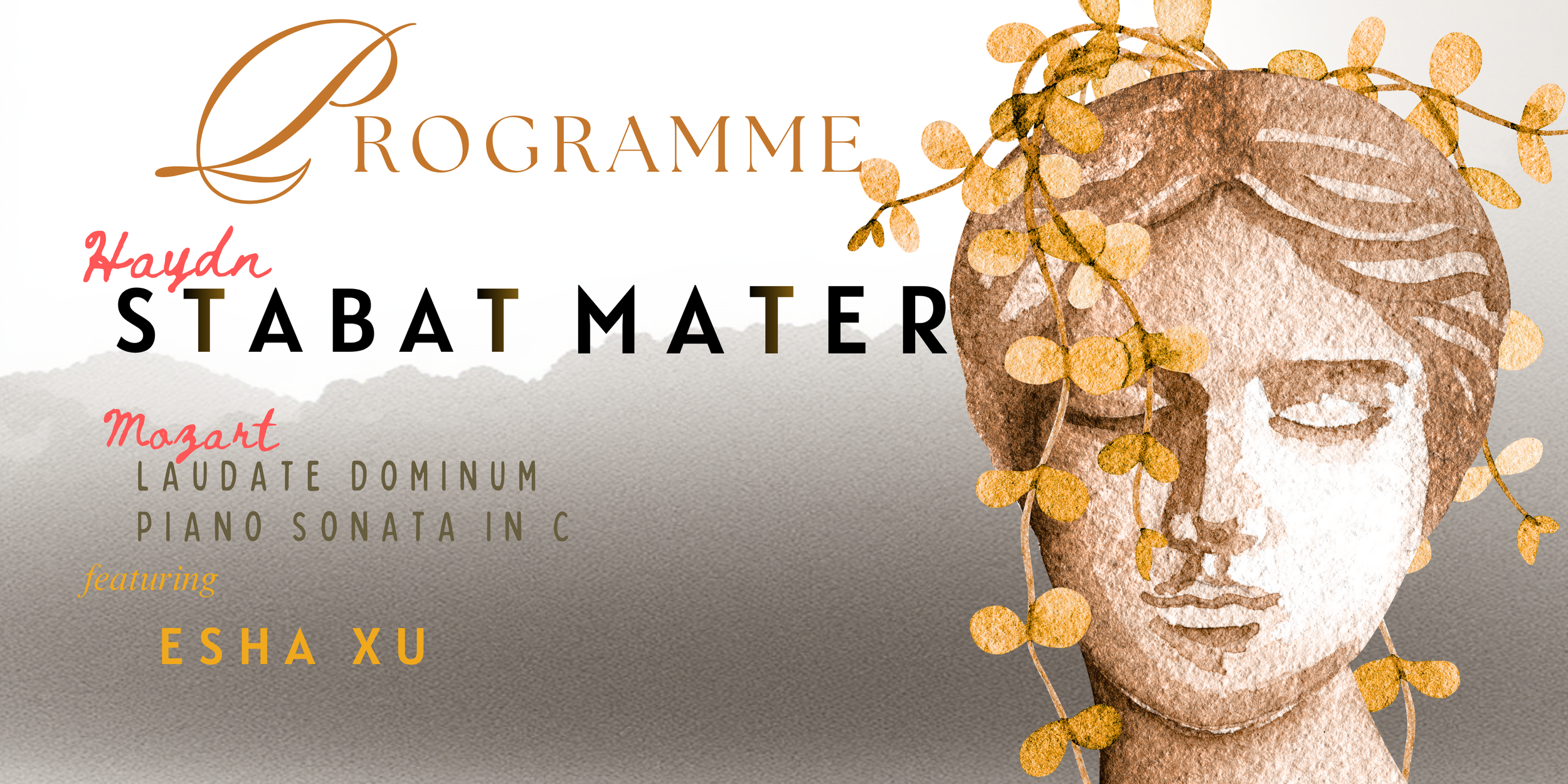
THE PROGRAMME
Laudate Dominum from Vesperae Solennes de Confessore, K. 339
Wolfgang Amadeus Mozart (1756 - 1791)
Piano Sonata No. 10 in C Major, K. 330
Wolfgang Amadeus Mozart (1756 - 1791)
I Allegro moderato
II - Andante cantabile
III - Allegretto
INTERVAL
(of approximately 20 minutes)
PROGRAMME NOTES
W. A. Mozart, Laudate Dominum
Mozart's two settings of the Vespers date from 1779 and 1780, during the brief period when he served as court organist
to the Archbishop of Salzburg. The Vesperae de Dominica is the earlier of the two and the one less frequently heard.
Each work consists of five psalm settings followed by a magnificat. Because these movements could be separated by
portions of the service, they are pieces that can stand alone, if needed.
Stylistically Mozart mixes learned counterpoint in the "old church style" (stile antico) with a more modern homophonic
and melodic style. In both works, that contrast is most striking at the moment when he shifts from the severe
counterpoint of the Laudate pueri to the Laudate Dominum which follows. In the Vesperae solennes de confessore, the
first of these two movements begins with a fugue on a subject that Mozart used again years later in his Requiem. That is
then followed by the famous, sublimely beautiful Laudate Dominum for soprano and chorus, a piece that was so popular
in the nineteenth century that it suffered all kinds of popular arrangements for different combinations of instruments,
much like the Pachelbel Canon in our time.
Mozart evidently thought well enough of both of his Vespers settings that, after he moved to Vienna, he asked his
fatherto send copies of them, so that he could show them to Baron van Swieten. Van Swieten, who was then introducing
Mozart to contrapuntal works of Bach and Handel, would no doubt have appreciated seeing the sections written in the
old style.
W. A. Mozart, Piano Sonata No. 10 in C Major
By early 1777, Mozart had grown discontent with his position under Archbishop Colloredo in Salzburg. Not only had
the composer become disenchanted by a lacklustre Salzburg orchestra and opera, but tensions in his relationship with
the Archbishop grew, not least due to Mozart's low salary. After much back-and-forth with the Archbishop, Mozart was
granted an extended leave of absence. He decided to visit Paris, with stops in Munich, Augsburg and Mannheim.
This sonata is one of a group of four (K.330 – 333) that were originally thought to have been composed in 1778 during
Mozart's stay in Paris, but are now known to date between 1781 and 1784 after Mozart had broken with the Archbishop
of Salzburg altogether and moved permanently to Vienna. This move, in 1781, was much against the wishes of his
father, as was his marriage the following year to Constanza Weber. The liberating effect of these assertive actions may
have provided the emotional base for a remarkable outpouring of confident works of mature genius: the six string
quartets that he dedicated to Haydn, the Haffner Symphony, numerous piano sonatas and concertos and the opera Die
Entführung aus dem Serail. His fame leapt.
The early 1780s were not only a time of great change in Mozart's personal and musical fortunes, they also saw the
arrival of substantially improved fortepiano instruments which had been developing in competition with the harpsichord
and clavichord over the previous half century. The sonata demonstrates an apparently easy mastery of classical form,
structurally simple and beguiling innocent. It is a masterpiece, in which every note belongs—one of the most loveable
works Mozart ever wrote. However, one of its most poignant moments – the last four bars of the second movement – is
apparently an afterthought, missing from the original manuscript, but present in the first edition.
F. J. Haydn, Stabat Mater
Haydn occupies a pivotal place in the history of Western music. In 1732, the year he was born, Bach, Handel, and
Vivaldi, composers whose music defined the High Baroque style, were still in their primes. By the time Haydn died
seventy-seven years later, Beethoven was already in his so-called middle period and hard at work ushering in the age of
Romanticism. Haydn’s lifetime thus neatly encompassed the Classical era, and his music reflects the “classical” virtues
of equilibrium, clarity, and seriousness of purpose that we associate with the Enlightenment. His influence was felt far
and wide, even though he spent virtually his entire career either in Vienna or in the idyllic seclusion of Prince Nicolaus
Esterházy’s country estates in present-day Hungary, where he served as resident Kapellmeister. After that productive
sinecure, so conducive to sustained creativity, came to a close in 1790, Haydn embarked on two extended sojourns to
London, where he wrote a clutch of popular symphonies that made him the toast of Europe. In 1795 Prince Nicolaus II
enticed the aging composer back to end his days in the Austrian capital. This late period yielded many of Haydn’s finest
works, including the oratorios The Creation and The Seasons and no fewer than six settings of the Roman Catholic
mass.By all accounts,
Haydn’s Catholic faith was as simple as it was sincere. “He was very strongly convinced in his heart that all human
destiny is under God’s guiding hand, that God rewards good and evil, and that all talents come from above,” wrote his
friend and biographer Georg August Griesinger. Intolerance, Griesinger observed, was foreign to the composer’s
accepting nature. “Haydn left every man to his own conviction and recognised all as his brothers. In general, his
devotion was not of the gloomy, always suffering sort, but rather cheerful and reconciled, and in this character,
moreover, he wrote all his church music.” It was thus in a spirit of joyous offering, rather than pious abnegation, that
Haydn penned the rubrics “Laus Deo” (Praise be to God) or “Soli Deo gloria” (Glory to God alone) at the end of his
manuscript scores. Indeed, to the composer of the profoundly humanistic oratorios inspired by the creation story and the
cycle of the seasons, the teachings of the Catholic Church were almost beside the point; as Haydn told a correspondent
who praised his musical re-enactment of the creation, he wanted nothing more than to give “peace and rest” to “the man
bowed down by care” or “burdened with business matters.”
The Stabat Mater exemplifies Haydn’s sanguine disposition in spite of its dolorous subject matter: Christ’s Passion on
the cross, the Virgin Mary’s grief at his suffering, and humankind’s salvation through
his sacrifice. Little is known about what prompted the thirty-five year old composer to choose this medieval Marian
hymn for the text of his oratorio in 1767. Indeed, his duties at the Esterházy court had only recently been expanded to
include church music. Prior to his promotion to the position of Kapellmeister in 1766, he had been responsible mainly
for writing symphonies and other instrumental music; the sacred-music portfolio was still in the hands of one Gregor
Joseph Werner, who had held the top post for nearly four decades. Haydn was characteristically modest about his work,
telling Count Esterházy that he had “translated” the Stabat Mater “into music according to the best of my powers.” Yet
both the Passion theme and the ambitious scale of the hour-long oratorio suggest that the new Kapellmeister intended to
make a splash. If so, he succeeded in spades: after the work’s premiere—which likely took place on Good Friday 1767
in the Esterházys’ private chapel at Eisenstadt—he sent the score of the Stabat Mater to Johann Adolph Hasse, a
renowned composer at the Habsburg court in Vienna. Hasse was suitably impressed and arranged for the oratorio to be
heard in the imperial capital. Further performances soon followed, many of them in nonliturgical concert settings, and
by the turn of the century the Stabat Mater had become the most frequently performed of all Haydn’s works. A leading
German music magazine hailed it as a “masterpiece . . . with deeply moving beauty and highly appropriate expressivity,
and the only one that could hold its ground next to Pergolesi’s.”
First performed in 1736, Giovanni Battista Pergolesi’s Stabat Mater was one of the most celebrated and widely
disseminated works of the eighteenth century. Haydn must have known it well; indeed, he almost certainly sang it as a
boy chorister at the Hofkapelle in Vienna. Like Haydn, Pergolesi was an experienced opera composer, and their
respective treatments of the Passion story are richly stocked with drama as well as melody. Haydn, however, worked on
a significantly grander scale than the Italian. Pergolesi’s chamber oratorio unfolds in a series of twelve solos and duets
for two high voices, accompanied by a small string ensemble. Haydn, in contrast, called for a four-part choir, four
soloists, and an orchestra. No fewer than sixty musicians took part in the first known public performance of the Stabat
Mater, which Haydn conducted from the keyboard in Vienna in 1771. In 1803, taking advantage of the resident
orchestra that the Esterházy prince had placed at his disposal in Eisenstadt. The presence of such “worldly” instruments
in the church was controversial, and Haydn was sharply criticised for mixing sacred and secular idioms; Antonio Salieri,
the powerful imperial Kapellmeister, dismissed his late masses as a stylistic “mishmash.” But Haydn was riding the
wave of the future: the dramatic elements in works like the Stabat Mater and the Schöpfungsmesse (Creation Mass)
anticipate the quasi-operatic masses of Berlioz, Verdi, and other Romantic composers.
To be sure, few stories are more inherently dramatic than that of Mary’s sorrowful vigil at the foot of the cross. Taken
together, the backstory of Christ’s sacrificial death and the sequel of humankind’s promised redemption conspire to
focus our attention on the emotional drama of the Virgin’s anguish. Her suffering, like her son’s, is at once personal and
universal: “Fac me cruce custodiri / morte Christi praemunire” (May the cross become my shield / through Christ’s
death may I be healed), the tenor soloist sings in gently insistent trochees, bearing witness for all humanity. Taking his
cue from the Latin text, Haydn strikes a judicious balance between present grief and hopeful expectation, with the
oratorio’s fourteen movements more or less evenly split between minor and major keys. The sequence of choruses, solo
arias, and ensembles reflects the composer’s keen sense of musical and dramatic pacing, as do his varied instrumental
accompaniments: only at the beginning and end of the oratorio does he deploy the orchestra in its full splendour. Much
of the vocal writing has a distinctly operatic character, complete with improvised cadenzas, in keeping with Prince
Nicolaus’s growing appetite for the art form. Elsewhere Haydn emulates the finely nuanced introspection and
expressive range of the so-called empfindsamer Stil (sensitive style) associated with contemporary composers like
Hasse and C.P.E. Bach.
Throughout the Stabat Mater, Haydn uses sudden dynamic contrasts and vivid text-painting to accentuate the drama of
Christ’s Passion. Both devices feature prominently in the opening tenor solo, “Stabat Mater dolorosa”; listen, for
example, for the syncopated palpitations in the orchestra as Mary’s soul is figuratively pierced by the sword of grief. In
the lightly tripping alto solo “O quam tristis et afflicta,” a
chromatically ascending phrase in the vocal line—the first of many such upwardly mobile melodic lines in the oratorio
—subtly reminds us of the resiliency of faith. The two ensuing movements express compassion for Mary in contrasting
registers: a majestic choral fugue in minor mode (“Quis est homo qui non fleret”) and a tender major-key arioso for solo
soprano (“Quis non posset contristari”). The mood changes abruptly in the snarling bass solo “Pro peccatis sua gentis,”
depicting the lash strokes of Christ’s tormentors. A tenderly consolatory tenor aria (“Vidit suum dulcem natum”) gives
way to three movements—the chorus “Eja Mater, fons amoris” the soprano-tenor duet “Sancta Mater, istud agas,” and
the alto solo “Fac me vere tecum flere”—in which the first-person hymnist begs to partake of Mary’s love and Christ’s
suffering. Soloists and chorus sing a fugal paean to the Virgin (“Virgo virginum praeclara”), followed by a vision of
Judgment Day in the tempestuous bass solo “Flammis orci ne succendar.” Lively “snap” rhythms characterise the
tenor’s plea to be shielded by the cross in “Fac me cruce custodiri.” Death stalks the descending chromatic melody in
“Quando corpus morietur,” but the hymnist’s thoughts quickly turn to the glory of paradise (“Paradisi gloria”), the
subject of the sparkling choral fugue that brings Haydn’s masterpiece to a close.
Stabat Mater, Hob XXa:1
Franz Joseph Haydn (1732 - 1809)
I - Stabat mater doloroso
Tenor Solo and Choir
II - O quam tristis at afflicta
Alto Solo
III - Quis est homo qui non fleret
Choir
IV - Quis non posset contristari
Soprano Solo
V - Pro peccatis suae gentis
Bass Solo
VI - Vidit suum dulcem natum
Tenor Solo
VII - Eja Mater, fons amoris
Choir
VIII - Sancta Mater, istud agas
Soprano and Tenor Solo
IX - Fac me vere tecum flere
Alto Solo
X - Virgo virginum praeclara
Soloists and Choir
XI - Flammis orci ne succendar
Bass Solo
XII - Fac me cruce custodiri
Tenor Solo
XIII - Quando corpus morietur
Soprano, Alto, and Choir
XIV - Paradisi Gloria
Soloists and Choir
THE PERFORMERS
Artistic & Musical Director:
Chalium Poppy
Guest Organist:
Jeremy Woodside
Soloists:
Soprano: Elizabeth Mandeno
Alto: Katrina Daniela
Tenor: Iain Tetley
Bass: James Harrison
The Scholars Baroque Aotearoa Chamber Choir
Sopranos: Freddy, Imogen, Regan, Catherine, Katherine, Gillian, Kortnee, Adriana
Altos: Tracy, Jill, Telina, Thelma, Jeany
Tenors: Eric, Peter, Ian, David Hall
Basses: Vince, Nico, Stephen, Laurence, Lee
Rehearsal Accompanist:
Mary Gentle
(Choir need to be confirmed and alphabetised according to last name)